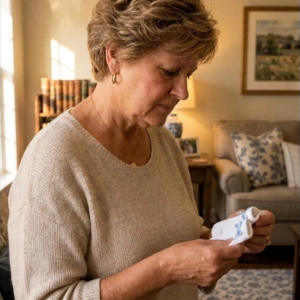
I wore my late mother’s jacket to a family gathering because it made me feel close to her. The fabric still carried a faint trace of her perfume, and wrapping myself in it felt like a quiet form of comfort. When my mother-in-law saw it, she curled her lip and said, “Did you steal that from a trash bag?” The words cut deep. What hurt even more was my husband’s reaction—he didn’t defend me, he only smirked, as if her cruelty was amusing. My chest tightened, my eyes burned, and I quietly grabbed my purse and left before anyone could see me break. I cried the entire drive home, wondering how something so meaningful to me could be reduced to a joke, and why the people who should have protected me chose silence instead.
A few days later, my mother-in-law showed up unannounced, her face pale and tense. Without greeting me, she walked straight into the bedroom and opened my wardrobe. She pulled out the jacket with shaking hands, then froze. Slowly, she traced the stitching inside the collar, where my mother had embroidered her initials years ago. Her expression changed. She whispered that the jacket looked exactly like one her own mother had worn, lost long ago during hard times. For the first time, her eyes filled with regret. She apologized—not just for the jacket, but for her cruelty. In that moment, I realized grief recognizes grief, even in unlikely hearts. The jacket was no longer just a memory of my mother; it became a reminder that empathy, though delayed, can still heal old wounds.